
How to Use Automation to Amplify Social Impact in NGOs
Discover how to use automation to amplify your NGO's social impact. Learn how to scale services, ensure transparency, and attract more resources with AI.
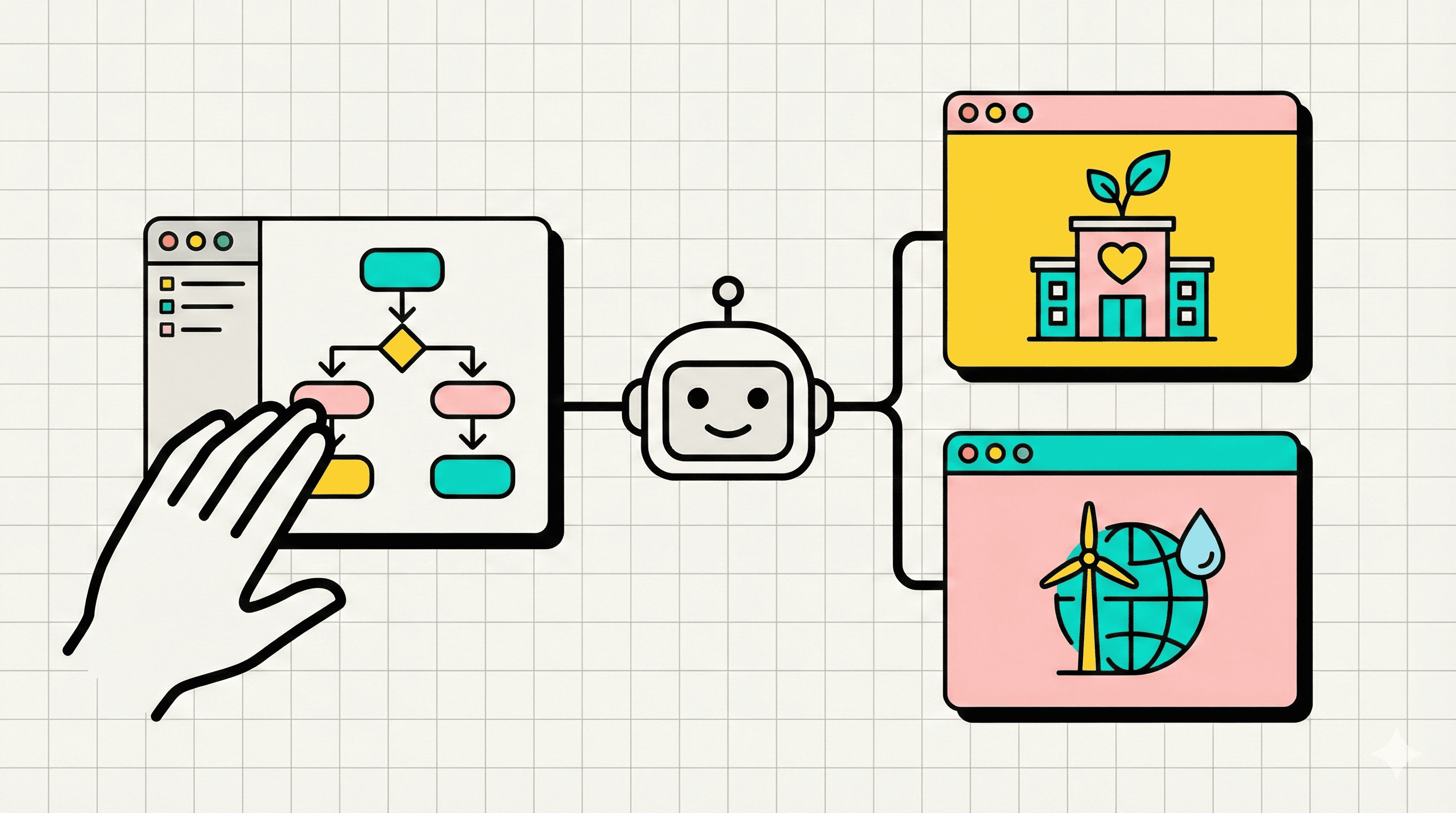
Brazil has more than 897,000 active civil society organizations, according to Ipea data (2024). But a reality still limits the transformative potential of these institutions: only 36% of Brazilian CSOs have their own website, and only 22% receive online donations. In a scenario where "technology must be inclusive" and transparency has become a prerequisite for fundraising, automation emerges not as a luxury, but as a strategic necessity for NGOs that want to scale their impact without multiplying costs.
This article presents a complete roadmap for NGO managers and government agencies to understand how process automation—far beyond administrative tasks—can be the key to serving more people, ensuring total auditability, and transforming raw data into measurable social results. Automation is not a cost, but a tool for multiplying impact.
The Social Sector Paradox: Why is Automation Urgent?
The Brazilian social sector faces a cruel paradox: while the social mission is great—serving vulnerable communities, promoting education, health, and human rights—the operational reality hits scarce resources and low digital maturity. Despite representing approximately 4.27% of the Brazilian GDP, the sector still operates predominantly manually.
The alarming data of 897,000 active CSOs reveals a worrying fragmentation: most of these organizations do not have basic digital tools to communicate their impact. This means disorganized spreadsheets, paper receipts, messages lost in WhatsApp groups, and reports assembled in a hurry to account to donors. This "cost of disorder" drains the time that should be spent on the frontline, serving beneficiaries.
More than ever, public and private calls for proposals demand professionalization. Organizations that cannot present structured data, clear KPIs, and auditable reports lose funding opportunities. The transition from amateurism to professional management has ceased to be optional—it has become a survival requirement. Automation, in this context, is the bridge between social mission and financial sustainability.
The question is no longer whether to automate, but when to start.
Administrative Automation vs. Impact Automation
There is a crucial difference between automating the "back-office" and automating the "frontline" of social impact. Understanding this distinction is fundamental to prioritizing investments and maximizing results.
Back-office Automation: The Basics to Survive
Administrative automation takes care of internal operational tasks:
- Automated emails for thanking donors
- Automatic issuance of donation receipts
- Financial control with bank integration
- Scheduled posts on social media
These automations free up team time but do not directly impact the service to the beneficiary. They are important, but insufficient to scale social impact.
Impact Automation: Technology at the Point of Service
The real revolution happens when automation reaches the frontline:
- Intelligent screening of beneficiaries via AI chatbots, which ask standardized questions, identify vulnerabilities, and direct them to the appropriate program.
- Real-time data collection in the field, using digital forms on tablets or smartphones.
- Continuous monitoring of social KPIs, with dashboards that show how many people were served, in which territories, and with what results.
- Automatic alerts when a beneficiary needs additional follow-up.
Practical example: An NGO that serves 200 families per month can, with automated screening via WhatsApp, identify priorities before the face-to-face meeting. The social worker already arrives at the home visit knowing exactly what that family needs. Service time drops by half, and impact doubles.
Technology "at the point" does not eliminate human care—on the contrary, it frees up the team for what really matters: listening, welcoming, and transforming. While AI takes care of screening and data, professionals dedicate themselves to empathy and strategy.
The Digital Maturity Trail: From Spreadsheet to Artificial Intelligence
The digital transformation journey in the social sector doesn't happen overnight. It is fundamental to follow a progressive trail to not overwhelm the team or compromise the operation. Below, we present four levels of digital maturity:
Level 1 - Organization: Data Centralization
The first step is to eliminate paper and centralize information:
- Digital registration of beneficiaries in a single place
- Service history accessible to the whole team
- Digitalized documents organized by folders
Goal: Abandon disconnected spreadsheets and lost emails.
Level 2 - Integration: Connecting Tools That Don't Talk to Each Other
At this stage, systems start talking to each other:
- Integration between CRM and WhatsApp Business
- Connection of Google Forms with database
- Synchronization of online donations with the financial system
Goal: Avoid double entry and data entry errors.
Level 3 - Scalability: No-Code Platforms
Now the NGO creates automatic service flows without needing programmers:
- Creation of intelligent forms that adapt to the answers
- Approval workflows for granting benefits
- Custom dashboards for each project coordinator
Goal: Serve 3x more people with the same team.
Level 4 - Intelligence: Generative AI and Predictive Analysis
The most advanced level uses artificial intelligence to:
- Analysis of territorial trends (where is demand growing?)
- Forecasting community needs in the coming months
- Automatic drafting of projects for calls for proposals, with AI adapting language to the funder's profile
- Identification of patterns that human teams could not see
Goal: Make strategic decisions based on data, not intuition.
Each organization advances on this trail at its own pace. The important thing is to start and evolve consistently.
Auditability: The Shortcut to Attract Investors and Calls for Proposals
One of the biggest challenges for Brazilian NGOs is accountability. Corporate donors, private companies, and international foundations prioritize organizations with traceable data and transparent management. Automation solves this problem structurally.
Why Do Donors Demand Traceable Data?
According to studies on fundraising, 81% of donors choose credibility as a crucial factor for donating. Transparency is no longer a differentiator—it is an obligation. Investors want:
- Real-time reports of where the money is being applied
- Concrete evidence of impact (how many people were served, with what results)
- Guarantee that there are no diversions or mismanagement
The Digital Trail: Every Service Documented
When the entire operation is digitalized, every action leaves a record:
- Who served which beneficiary, on what date, and with what result
- How much was spent on each program and what was the cost per service
- Which territories received more investment and what was the impact
This "digital footprint" allows for generating impact reports in minutes, not weeks. During an audit, just export data from the system—it is not necessary to search through papers and reconstruct histories.
Reducing Compliance Risks
Automation drastically reduces human errors in audits:
- Automatic data validation prevents duplicate or incomplete registrations
- Audit trails show who made each change and when
- LGPD compliance guaranteed by systems that manage consents and data anonymization
Organizations that master auditability not only account for their actions with ease—they gain the confidence necessary to access larger calls for proposals and long-term strategic partnerships.
No-Code and AI: Democratizing Technology for Lean NGOs
One of the biggest myths about automation is that it requires an army of programmers and million-dollar budgets. The reality of 2026 is very different: no-code platforms and generative AI have democratized access to technology.
What is No-Code?
No-code are platforms that allow creating technological solutions using visual interfaces, without writing a line of code. It's like putting together a puzzle: you drag blocks, connect stages, and create complete workflows.
Usage examples:
- Create a registration form that triggers automatic emails
- Build a project tracking dashboard
- Construct a chatbot that answers frequently asked questions
Advantage: The social leader themselves, without technical knowledge, can implement it.
Specialized Platforms vs. Generic Tools
There are generic tools like Zapier, Airtable, and n8n, very useful for simple automations. However, specialized platforms in the social sector—like CORRE.SOCIAL—offer decisive differentiators:
- Language adapted to the NGO context (they talk about "beneficiaries," not "customers")
- Pre-configured flows for screening, social follow-up, and accountability
- Ready-made social metrics (no need to create from scratch)
- Specialized support that understands the pains of the social sector
For lean organizations, using a specialized platform accelerates implementation and reduces the learning curve.
AI as a Strategic Assistant
Artificial intelligence in 2026 acts as a co-pilot for social managers:
- Drafting projects for calls for proposals, adapting language to the funder's profile
- Territorial impact analysis, identifying patterns and trends
- Generation of narrative reports from structured data
- Action suggestions based on service history
AI does not replace the manager's expertise—it amplifies their decision and production capacity.
First Steps: What to Automate First?
For organizations starting out, the secret is to start small and prove the value before scaling. Below is an immediate action guide:
1. Quick Diagnosis: Where is the Bottleneck?
Gather your team and answer:
- Which task consumes the most time without adding direct value to the beneficiary?
- Where do data get lost or disorganized?
- Which process is a constant source of rework or errors?
The answers indicate where to start.
2. Suggested Flow for First Automation
For most NGOs, we recommend starting with one of these two flows:
Option A - Screening of New Beneficiaries:
- Create a digital registration form (can be Google Forms or similar)
- Configure automatic email or WhatsApp replies confirming receipt
- Centralize answers in a spreadsheet or system that the whole team accesses
- Create automatic alerts when a priority registration arrives
Option B - Automated Feedback for Donors:
- Configure automatic thank-you email immediately after donation
- Send automatic quarterly report showing where the money was applied
- Create a public transparency dashboard that donors can access 24/7
These automations are simple, but they generate an immediate impact on the perception of professionalism and efficiency.
3. Culture of Experimentation
The most important thing is to create a culture of experimentation:
- Test, measure, adjust—do not seek perfection on day one
- Involve the team from the start to reduce resistance
- Celebrate small victories to maintain motivation
Automation is a journey, not a destination. Each small step forward frees up time and resources for the next stage.
Quick Glossary of Technical Terms
To facilitate understanding, check some terms that appear along the automation journey:
No-Code: Platforms that allow creating technological solutions without writing code, using visual interfaces.
KPI (Key Performance Indicator): Key metrics that show if objectives are being achieved.
Chatbot: A conversational robot that interacts with users via text, answering questions and collecting information.
API (Application Programming Interface): A bridge that allows different systems to talk to each other and exchange data automatically.
LGPD (General Data Protection Law): Brazilian legislation that regulates how personal data should be collected, stored, and protected.
Dashboard: A visual panel that brings together metrics and indicators in real-time, facilitating decision-making.
Conclusion: Automation as an Impact Multiplier
The Brazilian social sector is at a turning point. The 897,000 active organizations have an immense potential for transformation, but only those that adopt technology strategically will be able to scale their impact sustainably.
Automation is not about replacing people with machines—it's about freeing professionals to do what only humans can: listen with empathy, make complex ethical decisions, and build transformative bonds. Meanwhile, systems take care of screening, data organization, and reporting.
In the scenario of 2026, where artificial intelligence is increasingly used in the social sector and no-code platforms democratize access to technology, there are no more excuses to remain in the analog era. Starting small, proving value, and scaling gradually is the recipe for organizations that want to multiply impact without multiplying costs.
Is your NGO ready to take the next step?
If you want to perform a digital maturity diagnosis and find out where to start automating processes in your organization, get in touch with specialists who understand the reality of the social sector. Transformation begins with a decision—and the time is now.
About CORRE.SOCIAL: A no-code platform specialized in NGOs and governments, transforming expertise into technological solutions, automating operations, and generating auditable data to prove social impact.